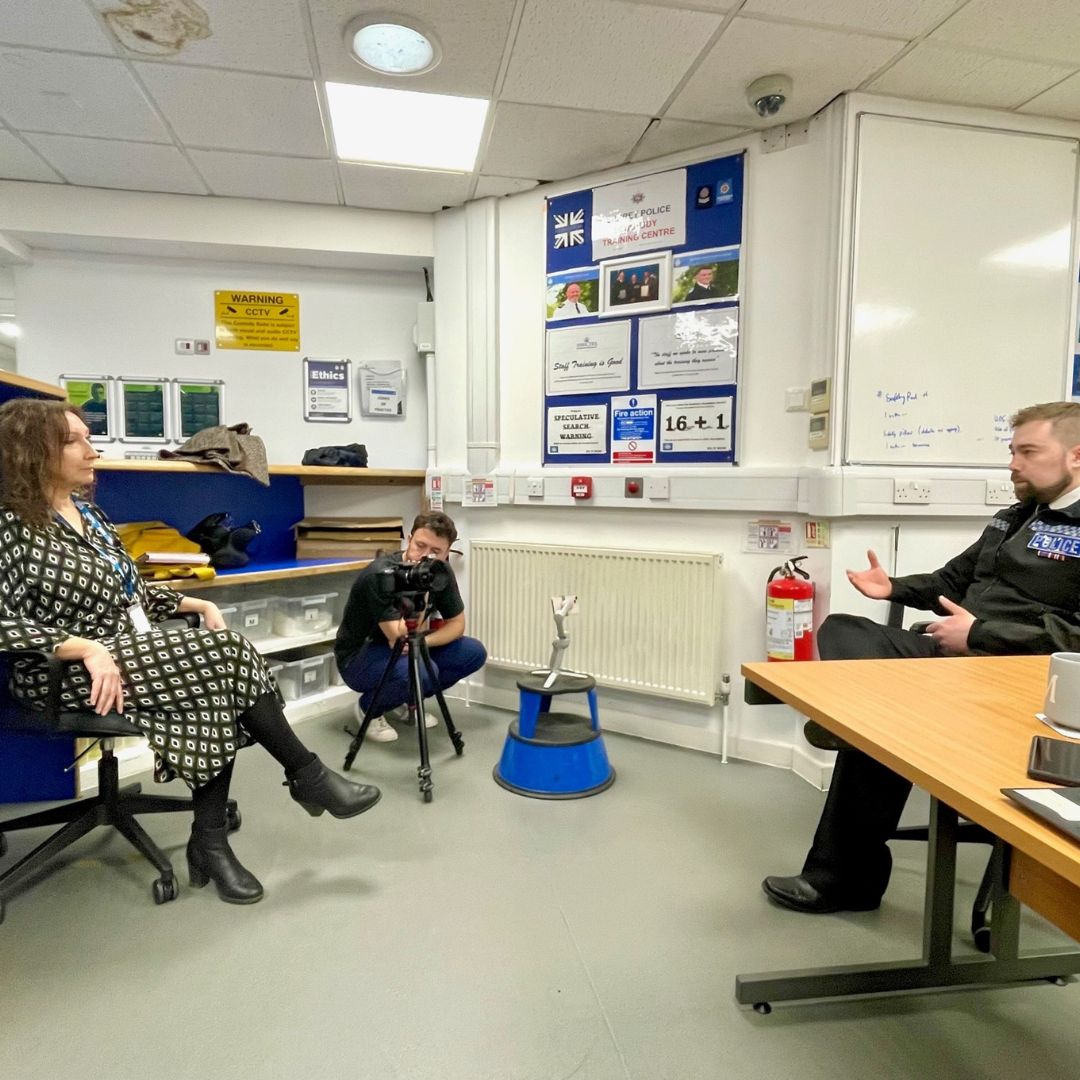


Op NOVA caseworker Lisa Mayell was excited to join Acting Inspector Mark Simpson to learn about Surrey Police’s new trauma-informed custody suites. They shared a quick tea break to talk about how the changes will better support her veteran cohort.
The police custody suite is often the first point of interaction with the justice system. It is also one of the earliest and most common Op NOVA referral opportunities. Referrals from custody suites are typically made by police officers and NHS liaison and diversion teams and comprise over 67% of all Op NOVA referrals in England.
However, the traditional custody suite environment can be an overwhelming environment, particularly for those with vulnerabilities and complex needs.
“Coming into custody can be both visually and audibly noisy. Historically, they’ve been built to contain rather than foster any sense of collaboration, so they often lack daylight and can feel pretty bleak and sterile. Ultimately, it’s not a conducive environment for our staff or detainees,” explains Acting Inspector Simpson.
Lisa agrees: “Veterans often arrive at the custody suite in a state of agitation and distress. For veterans living with mental health conditions, PTSD or neurodiversity, it can be a very overwhelming & challenging environment. We know that many veterans ‘shut down’ in these situations and will be less receptive to any support offered – a more calming environment could be transformative for the veteran community.”
Transforming the custody suite experience
The new custody suite has been refurbished in consultation with a clinical psychologist from Surrey and Borders NHS Foundation Trust, who made several recommendations on creating a more trauma-informed environment that would benefit both staff and detainee welfare.
A calming colour palette was one of the first recommendations Surrey adopted. “We learned that small things, such as colour palettes, can have a big overall impact. Our previous whitewash walls look hygienic, but from a neurodiverse perspective, the light reflects and contributes to a more oppressive environment,” adds Acting Inspector Mark Simpson.
The new custody suites are painted in calming greens and light purples. It’s a small but informed step change towards improving both staff and detainee welfare.
“What we want to create an environment that can keep people as calm as possible. When people feel calm, they’re more likely to engage with the interview process. And that’s what custody is about. It’s about giving people a fair opportunity to answer the allegations against them.”
Detainees also typically meet professionals from the NHS liaison and diversion service whilst in custody. For many veterans, this is a key interaction, with potentially life-changing outcomes.
“Keeping veterans calm and cooperative in custody suites ensures that they are best able to access and engage with professionals who can help. These interventions can play a huge role in breaking cycles, changing behaviours and helping them to move beyond the justice system,” adds Lisa.
Trauma-informed policing works for everyone
A highly experienced custody officer, Acting Inspector Simpson believes trauma-informed strategies reduce the likelihood of forced interventions and help free up police time.
“If someone becomes agitated, it can often manifest as aggression or an intent to self-harm. We don’t want to take officers off the streets to sit in cells to manage that risk and we certainly don’t want to have to use force to keep that person safe. Using available research and resources to keep people calm in custody is a good investment.”
Other resources used by Surrey Police include distraction items such as fidget spinners and foam stress balls.
“It’s as simple as it sounds – if people can be distracted from their immediate surroundings, it can relax them into the process. I’ve witnessed this have great effect.”
Changing the narrative: from ‘dark and dingy’ to calm and cooperative
There is a growing evidence base for trauma-informed approaches, and Acting Inspector Simpson believes this will grow and develop:
“We’ve made good headway in things like distraction items in Surrey; we’ve been quite innovative and we’ve seen it work. I think policing as a whole is going down this path, and I think we’re all the better for it.”
“It’s cost-efficient and pragmatic. It doesn’t cost a lot to make a few small improvements. For example, painting a wall in the exercise room with blackboard paint has proved effective in managing emotions. We’ve also painted goals on walls and provided foam balls that people can throw around the cell. When occupied with distraction strategies, we’ve found they’re not actively looking at opportunities to self-harm or become agitated and aggressive. In turn, this reduces the potential for assaults against custody staff. Small changes can go a long way.”
The use of trauma-informed strategies in the justice system is growing, with access to books, mindful activities, digital information and music becoming more common. Although seemingly small initiatives, there is a growing understanding of their impacts on detainees’ wellbeing, police time and outcomes for victims and communities.
“In terms of what custody is meant to be, we are changing the narrative. Perhaps there is still a perception that custody is meant to be a dark and dingy place, but this is changing’.
“My advice to anyone is to give trauma-informed strategies a go. Here at Surrey, we’ve taken steps forward with small things like colour palettes, distraction aids and art materials. They’ve made a massive difference. Some of the in-cell artwork has been incredible!”
Op NOVA would like to thank Acting Inspector Mark Simpson for sharing his expertise to better support the veteran community. You can watch snippets of this interview on Op NOVA’s Facebook page, with new clips being released throughout June and July 2025. #ThinkVeteranThinkNova
Further information
Contact us to refer a veteran or find out more about Op NOVA.
Op NOVA is the NHS-commissioned support service for veterans in the justice system in England. Since launching in April 2023, it has supported over 2,742 veterans.